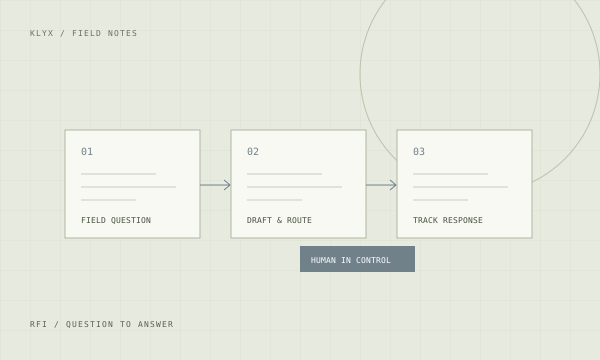
Detection was never the bottleneck
Coordination software has been able to find geometric conflicts between models for a long time, and it finds thousands of them. The output is a report. What determines whether the field benefits is everything after the report: deciding which clashes are real, determining who moves, getting agreement, updating the models, and communicating the resolution to the crew that will install the work.
Improving detection with better algorithms addresses the part of the process that was already working. The delays and the field conflicts come from the resolution workflow, which in most cases is a coordination meeting and a spreadsheet.
Filter to what matters before assigning anything
A raw clash report includes conflicts that do not matter: items within tolerance, elements that are not actually installed as modeled, insulation overlaps that resolve themselves in the field, and duplicates of the same underlying condition. Sending the raw list to trade partners buries the genuine problems and trains everyone to ignore the report.
Filtering and grouping is a good application of automated classification. Cluster related clashes into single conditions, suppress known tolerance categories, and rank by installation sequence so the conflicts in areas starting next month appear first. A prioritized list of forty real conditions produces action. A list of three thousand does not.
Every condition needs an owner and a date
The step most often missing is assignment. A clash is identified, discussed in a coordination meeting, and left in a state where two trades each believe the other is moving. Weeks later the condition arrives in the field unresolved and becomes a stoppage and an RFI.
Treat each condition like an RFI: a named responsible party, a required resolution date driven by the installation schedule, a documented decision, and a status that is visible without attending a meeting. The coordination meeting then reviews exceptions rather than rediscovering the same items.
Close the loop with the field
A resolution recorded in a coordination model helps nobody if the installer is working from a drawing set that does not reflect it. Getting resolved conditions into the hands of the crew, in a form they will actually use, is the step that converts coordination effort into installed work that fits.
Then measure the return. Count field conflicts, coordination-related RFIs, and rework in coordinated areas versus areas that were not coordinated. If the numbers do not differ, the coordination process is producing documentation rather than outcomes, and the fix is in the resolution workflow rather than in the detection tool.
Model accuracy determines everything downstream
Coordination is only as good as the models feeding it. Trade models built at different levels of detail, elements modeled schematically rather than as they will be installed, missing support and hanger systems, and equipment modeled without service clearances all produce coordination that looks complete and fails in the field.
Agree on modeling requirements at the start: what gets modeled, at what level of detail, including access and maintenance clearances, and who verifies compliance. This conversation is tedious and it is where coordination outcomes are actually determined. Detection run over inconsistent models generates confident reports about a building that does not exist.
