Why drywall change orders go unbilled (and what it costs to carry them)
The crew finished the extra. The office is still trying to assemble the record. Follow the handoffs before blaming the people carrying them.
Straightforward guides to AI, project operations, and the administrative work that connects the office to the field.
The crew finished the extra. The office is still trying to assemble the record. Follow the handoffs before blaming the people carrying them.
Before asking your estimator to win a higher percentage, find out how many qualified packages actually reach their desk ready to price.
This is about administrative rejections: the work is represented, but the package is missing something the reviewer requires. The fix starts before submission.
The equipment list says you own it. The new job rented one anyway. Before blaming the decision, check whether anyone could establish that the owned item was available.
A polished meeting summary does not establish who agreed to do what. Use AI to draft a source-backed action register, then have the project team confirm owners, dates, and decisions before distribution.
Most lookahead schedules are a reformatted copy of the master schedule, which is why nobody reads them. A lookahead earns attention when it tracks constraints and commitments instead of restating intentions.
Subcontractor and supplier invoices arrive in every format a vendor can think of, and the cost of processing them badly shows up as lost discounts, double payments, and margin you cannot explain. Here is what to automate first.
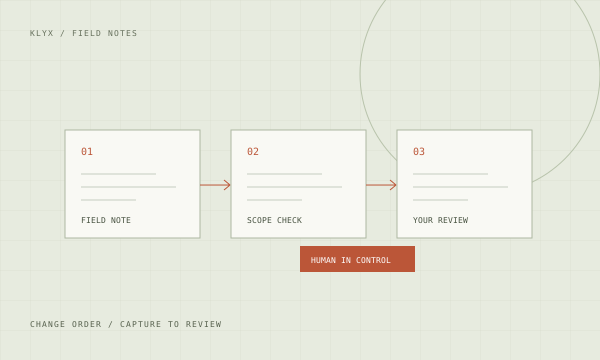
A practical workflow for turning field directions into documented, reviewable changes before the job reaches closeout.
Choose one repeatable workflow with a clear owner, reliable inputs, and a result your team can actually check.
Build a follow-up process that keeps unanswered questions visible without creating another spreadsheet to maintain.
A grounded look at where artificial intelligence in construction earns its keep today, which claims to ignore, and how to pick a first workflow that pays for itself.
AI can compress the clerical half of estimating without touching the judgment half. Here is how commercial contractors separate the two and bid more work with the same team.
Most contractors do not have a bidding problem. They have a bid tracking problem. A practical system for logging invitations, owning go or no-go decisions, and following up.
Extra work performed and never properly documented is one of the most common margin losses in commercial construction. A workflow for catching changes at the source.
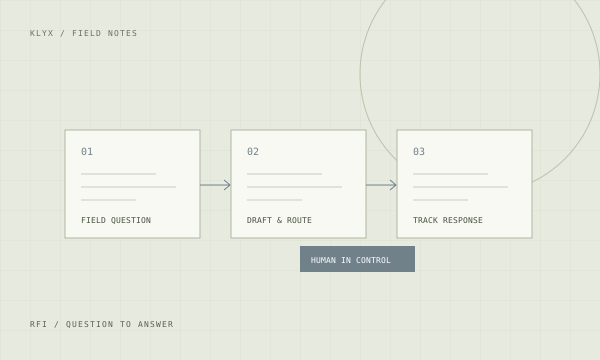
An unanswered RFI is a crew waiting. A practical approach to drafting, routing, and chasing requests for information without living in your inbox.
Submittal packages get assembled by hand, revised by hand, and tracked in a spreadsheet nobody trusts. A better path from specification section to approved package.
You do not need to replace your project management system to automate the work around it. A sequenced plan for commercial contractors, starting with one workflow.
Plans, specs, transmittals, invoices, and correspondence pile up faster than anyone files them. How AI-assisted document handling makes project records findable and usable.
The schedule rarely slips all at once. It slips through unanswered questions, late approvals, and material dates nobody checked. Where analysis helps and where it oversells.
Preconstruction runs on incomplete information and short deadlines. How AI assistance speeds up scope review and historical cost comparison while keeping the numbers accountable.
Safety programs fail on paperwork more often than on intent. How automation keeps toolbox talks, inspections, and incident records complete without adding field burden.
Work in progress reporting and pay application preparation eat the same week every month. Where the repetitive parts can be automated and where accounting judgment stays.
You cannot hire your way out of a skilled labor shortage quickly. You can stop spending experienced people's hours on work that does not require experience.
Material cost volatility and manual purchase order handling quietly reduce margin on fixed-price work. A practical procurement workflow for commercial contractors.
Tools disappear, rentals stay out past their need date, and nobody is sure what is on which job. A tracking approach that field crews will actually use.
Insurance certificates expire, licenses lapse, and financial information goes stale. How general contractors keep prequalification current without a full-time administrator.
Payment delays in commercial construction are usually documentation failures, not disputes. How to make the billing package complete on the first submission.
Closeout is where retainage sits and profit gets eroded. A workflow for punch items, closeout documents, and getting the final payment released.
Relationships win commercial work, but relationships tracked in one person's head do not scale. A lightweight CRM approach built around how contractors actually sell.
Generic AI-written proposals lose work. Here is how to use language models for the assembly and boilerplate while keeping the judgment and voice that win jobs.
Most contractor dashboards report what is easy to collect rather than what changes decisions. A short list of operational metrics that are worth the effort to track.
Your project platform holds project data. Your accounting system holds cost. Your email holds everything else. How to connect them without a rebuild.
Daily reports are the contractor's contemporaneous record and the most commonly skipped paperwork on a job. How to make them complete without adding an hour to the day.
Automated takeoff has improved enough to be useful and not enough to trust unchecked. How to structure the review so you capture the speed without importing the errors.
A low win rate is usually a targeting problem, not a pricing problem. How to find out which work you actually win and stop spending estimating hours on the rest.
Profitable contractors fail on cash, not on margin. A forecasting approach built from the project data you already produce, updated without a monthly scramble.
Thousands of jobsite photos are worthless if nobody can find the right one. How to capture, organize, and retrieve visual evidence that actually supports a position.
Project email is where directives, approvals, and commitments hide. A triage approach that turns an unmanageable inbox into a reviewed queue with owners.
Warranty calls arrive months after the job is closed, to a team that has moved on. How to handle them without losing the relationship or absorbing costs you do not owe.
New project engineers take months to become productive because the knowledge lives in people's heads. How to capture it and shorten the ramp without pulling seniors off work.
Vendor return-on-investment claims are built on assumptions about your business that may not hold. A method for producing a number you can defend to your own leadership.
Staff are already using AI tools with company information. A short, practical policy that protects the business without pretending the technology can be banned.
Prefabrication succeeds or fails on information timing. Where automation helps coordinate design release, shop capacity, and field sequence for commercial contractors.
Clash detection produces long reports and limited field benefit when the resolution process is missing. How to turn detected clashes into resolved conditions.
Jobs rarely go bad suddenly. They go bad gradually while the reporting still looks fine. The signals that appear early and how to surface them weekly.
The construction technology market is crowded with similar claims. A short set of questions that separates vendors who understand contracting from those who do not.
We’ll discuss how work moves through your company, identify where to investigate first, and determine the scope of an operations audit.
Walk away with a map of how work moves through your office and a ranked list of what to investigate and fix first.
A real conversation. With the person who builds it.